
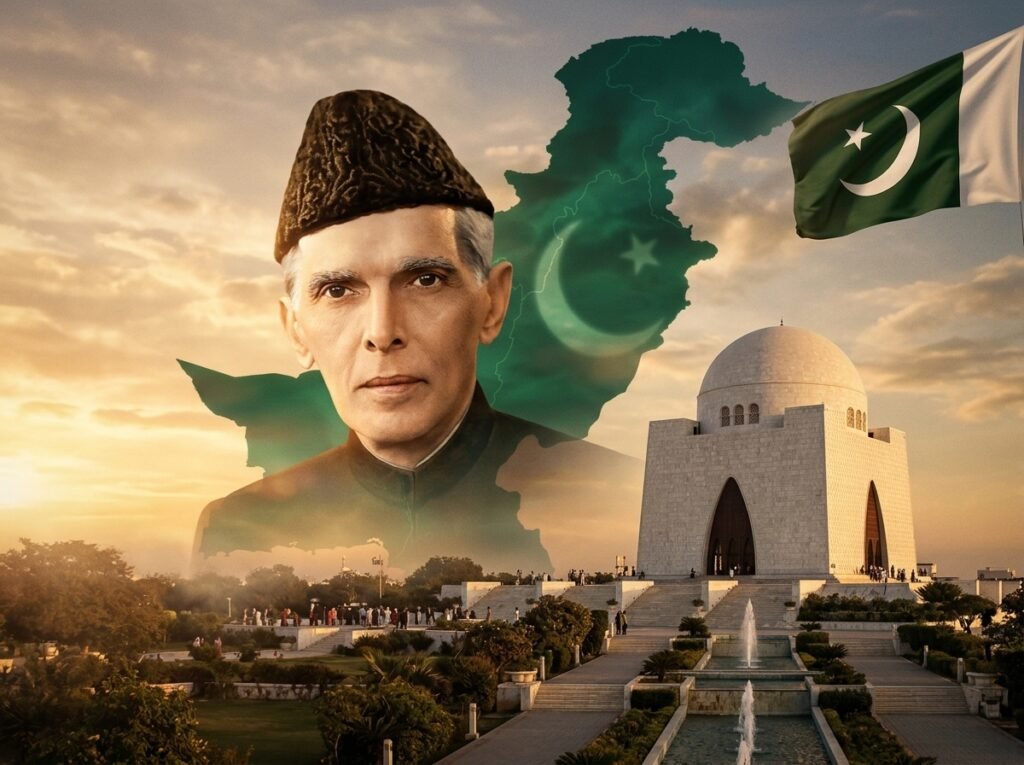
Quaid e Azam Ali Jinnah: From Wazir Mansion to a Nation
Quaid e Azam Ali Jinnah, the founder of Pakistan and its first Governor-General, was born in Karachi on December 25, 1876, and died there on September 11, 1948. He lived just over a year after the country he fought for came into being.
Pakistanis honour him as Quaid e Azam, which means “Great Leader,” and as Baba-e-Qaum, the “Father of the Nation.” This biography covers his early life, his political journey, his death and the monument that marks his grave.
Quaid e Azam Quick Facts
| Detail | Information |
|---|---|
| Full name | Muhammad Ali Jinnah (born Mahomedali Jinnahbhai) |
| Titles | Quaid e Azam (Great Leader), Baba-e-Qaum (Father of the Nation) |
| Born | December 25, 1876, Wazir Mansion, Karachi |
| Died | September 11, 1948, Karachi, aged 71 |
| Parents | Jinnahbhai Poonja and Mithibai |
| Profession | Barrister and statesman |
| Education | Lincoln’s Inn, London |
| Highest office | First Governor-General of Pakistan |
| Resting place | Mazar-e-Quaid, Karachi |
When Was Quaid e Azam Born?
Quaid e Azam was born on December 25, 1876, at Wazir Mansion in Karachi, then part of British India. He was the eldest of seven children in a prosperous merchant family.
His father, Jinnahbhai Poonja, traded in hides and cotton. His mother was Mithibai. Their family had moved to Karachi from Kathiawar on India’s west coast.
One note for accuracy: his earliest school register suggests a birth date of October 20, 1875. Pakistan officially observes December 25, 1876, which is the date his first biographer gave and the one used in nearly every reference.
Early Life and Education of Quaid e Azam Jinnah
Jinnah began his schooling in Karachi, including at the Sind Madressatul Islam, and later attended a mission school. At 16 he sailed to London to train in business, but he soon switched to law.
He joined Lincoln’s Inn and qualified as a barrister at a very young age. Back in India, he built a strong legal practice, first in Bombay.
His personal life had sorrows. His first marriage, to Emibai in 1892, ended with her death in 1893. In 1918 he married Rattanbai Petit, who died in 1929. They had one daughter, Dina, who later became Dina Wadia.
When Did Quaid e Azam Join Congress?
Quaid e Azam first entered politics in 1906. He attended the Calcutta session of the Indian National Congress as private secretary to its president, Dadabhai Naoroji.
Some accounts mention earlier contact with Congress gatherings in 1904, but 1906 is the year most historians give for his entry into active politics.
At that time he argued for Hindu-Muslim unity. He was elected to the Imperial Legislative Council in 1910 and became known as a sharp, independent voice.
When Did Quaid e Azam Join the Muslim League?
Quaid e Azam joined the All-India Muslim League in 1913. Leaders such as Maulana Mohammad Ali and Syed Wazir Hassan urged him to join.
Jinnah had avoided the League at first. Muslim leaders founded it in 1906, and he thought it focused too narrowly on Muslim interests. He agreed to join after League leaders assured him that it also cared about Indian self-government.
For several years he belonged to both organisations. He worked hard to bring them together.
The Lucknow Pact and the Break With Congress
In 1916 Jinnah presided over the League’s session in Lucknow. That year the League and Congress signed the Lucknow Pact, a joint plan for political reform. It is seen as the high point of his push for Hindu-Muslim cooperation.
Things changed as Gandhi’s influence grew in Congress. Jinnah disagreed with the methods of mass agitation and left Congress in 1920.
He stayed active in politics and law. In 1929 he put forward his Fourteen Points as a statement of Muslim demands for a future constitution, and he took part in the Round Table Conferences in London in the early 1930s.
The Road to Pakistan
By the mid-1930s Jinnah returned to India and took charge of rebuilding the Muslim League. He travelled widely, built party branches and won the trust of Muslims across the subcontinent.
It was in this period that people began calling him Quaid e Azam, the Great Leader.
On March 23, 1940, the League adopted the Lahore Resolution at its session in Lahore. It called for independent states in the Muslim-majority regions of the subcontinent. It became the political foundation for the demand for Pakistan.
Seven years later the demand was met. Pakistan came into being on August 14, 1947.
Quaid e Azam as Governor-General of Pakistan
Jinnah became the first Governor-General of Pakistan and took office on August 14, 1947. He faced huge tasks. Millions of migrants crossed the new borders, the government had few resources, and his team had to build the state from scratch.
He urged the nation to follow three principles: unity, faith and discipline. Pakistani schools still teach these words.
He worked at a punishing pace, even though his health was failing. Only his sister, Fatima Jinnah, and a few close associates knew how serious his illness was.
Quaid e Azam Date of Death: When Did Quaid e Azam Die?
Quaid e Azam died on September 11, 1948, in Karachi, at the age of 71. He had suffered from tuberculosis for a long time. His death came barely 13 months after Pakistan’s creation.
His state funeral took place the following day, on September 12, 1948. Khawaja Nazimuddin succeeded him as Governor-General.
The Quaid e Azam date of death is remembered across Pakistan every year with ceremonies and prayers.
Quaid e Azam Mazar Karachi: The National Mausoleum
The Quaid e Azam Mazar in Karachi, known as Mazar-e-Quaid, is his final resting place and one of the city’s best-known landmarks. After his death, his grave was first marked by a simple marble slab.
The government planned a permanent tomb in the late 1950s. Officials rejected several early designs. Fatima Jinnah then backed the Indian architect Yahya Merchant, and the committee chose his design.
Construction began in 1960, and workers completed the mausoleum on June 2, 1970. The mausoleum opened to the public in January 1971. Its total cost was about Rs 14.8 million, according to the official Mazar-e-Quaid Management Board.
The white marble structure blends modern design with Islamic and Mughal elements, and it rises about 43 metres. A four-tiered crystal chandelier gifted by China hangs inside.
Beside the Mazar-e-Quaid rest his sister Fatima Jinnah and Liaquat Ali Khan, Pakistan’s first prime minister.
What Does Quaid e Azam Zindabad Mean?
Quaid e Azam Zindabad is a patriotic slogan that means “Long live the Great Leader.” It is chanted at national events, rallies, school assemblies and ceremonies, especially on days that mark his birth and death.
The slogan is often joined with “Pakistan Zindabad.” Together they express national pride and loyalty to the founder’s vision.
Quaid e Azam Day on December 25
Quaid e Azam Day is observed every year on December 25, his birthday. It is a national holiday in Pakistan.
Across the country, people hold flag ceremonies, speeches, seminars and school events. Many visit the Mazar-e-Quaid in Karachi to lay flowers and offer prayers. His death anniversary on September 11 is also marked with remembrance events.
Quaid e Azam Essay: Key Points for Students
Students often need a Quaid e Azam essay for school or exams. Here is a simple structure that works well.
Introduction: Name him, say he founded Pakistan, and give his birth and death dates.
Early life: Mention his birth in Karachi in 1876, his education and his legal training at Lincoln’s Inn.
Political career: Cover Congress in 1906, the Muslim League in 1913, the Lucknow Pact and the Lahore Resolution of 1940.
Creation of Pakistan: Describe independence on August 14, 1947, and his role as first Governor-General.
Death and legacy: Mention his death on September 11, 1948, the Mazar-e-Quaid and his motto of unity, faith and discipline.
A sample opening line: “Quaid e Azam Muhammad Ali Jinnah was the great leader who turned the dream of a separate homeland for Muslims into a reality.”
Quaid e Azam Jinnah Timeline
- 1876: Born in Karachi on December 25.
- 1892: Travels to London to study.
- 1906: Attends the Calcutta session of Congress.
- 1913: Joins the All-India Muslim League.
- 1916: Presides over the Lucknow session and the Lucknow Pact is signed.
- 1920: Leaves Congress.
- 1929: Presents the Fourteen Points.
- 1940: The League adopts the Lahore Resolution on March 23.
- 1947: Pakistan is created on August 14, and he becomes Governor-General.
- 1948: Dies on September 11 in Karachi.
The Legacy of Quaid e Azam Jinnah
Quaid e Azam Jinnah shaped the political future of South Asia. A lawyer by training, he used constitutional methods, patient negotiation and firm leadership to reach his goal.
His image appears on Pakistani currency, and many streets, institutions and landmarks carry his name. His portrait hangs in government offices across the country.
The message of unity, faith and discipline by him remains central to how Pakistan remembers its founder.
Frequently Asked Questions
When did Quaid e Azam join Congress?
Quaid e Azam took part in the Indian National Congress in 1906, when he attended its Calcutta session as private secretary to Dadabhai Naoroji. He stayed in Congress until 1920.
When did Quaid e Azam join the Muslim League?
He joined the All-India Muslim League in 1913. He became its leading figure and led it until Pakistan was created in 1947.
When did Quaid e Azam die?
Quaid e Azam died on September 11, 1948, in Karachi at the age of 71. He had been suffering from tuberculosis. His state funeral was held on September 12.
When was Quaid e Azam born?
He was born on December 25, 1876, at Wazir Mansion in Karachi. Pakistan observes this date as Quaid e Azam Day.
What is Quaid e Azam Day?
Quaid e Azam Day is observed on December 25 each year to mark his birthday. It is a national holiday with ceremonies, speeches and visits to his mausoleum.
Where is the Quaid e Azam Mazar?
The Quaid e Azam Mazar, known as Mazar-e-Quaid, is in the centre of Karachi. It is a white marble mausoleum completed in 1970 and designed by architect Yahya Merchant.
What does Quaid e Azam Zindabad mean?
It means “Long live the Great Leader.” People chant it at national events and ceremonies to honour Jinnah.