Why the Russia Ukraine War Is Sending Dead Princes to Battle
As the Russia Ukraine war grinds through its fifth year, Moscow has found an unusual new tool to boost morale at the front: the remains of a warrior prince who died more than six centuries ago.
A fragment of the remains of Dmitry Donskoy, celebrated for his 1380 victory at the Battle of Kulikovo, was sent to Russian troops on the eastern Ukraine front in early September. It is now being circulated among military bases in Russian-occupied Ukraine.
A Saint Commander on the Front Lines
The military department of the Moscow Patriarchate, the Russian Orthodox Church’s clerical leadership, said the “saint commander” would invisibly stand shoulder to shoulder with soldiers. Officials noted the relic is a fragment of the same hand Donskoy used to wield his sword at Kulikovo.
Since the invasion began in 2022, the Kremlin has leaned on religious symbolism. To frame its actions as righteous and divinely sanctioned. That effort has pulled the Russian Orthodox Church and the state closer together than at any point in recent memory.
“The church has practically merged with the state to the point of being indistinguishable,” said Sergei Chapnin. A religious scholar at Fordham University’s Orthodox Christian Studies Center.
A Mobilizing Myth
Sending sacred relics to soldiers is a long tradition in Orthodox Christianity. But experts say the practice now carries a political message too. Chapnin described the Donskoy relic as part of a “mobilizing myth” meant to cast Russia as a defender rather than an aggressor in the Russia Ukraine War.
Donskoy is not the only historical figure invoked this way. Relics of Prince Alexander Nevsky, another medieval military hero, were also brought to troops earlier this year. Following unverified reports that the Nevsky relics had gone missing.
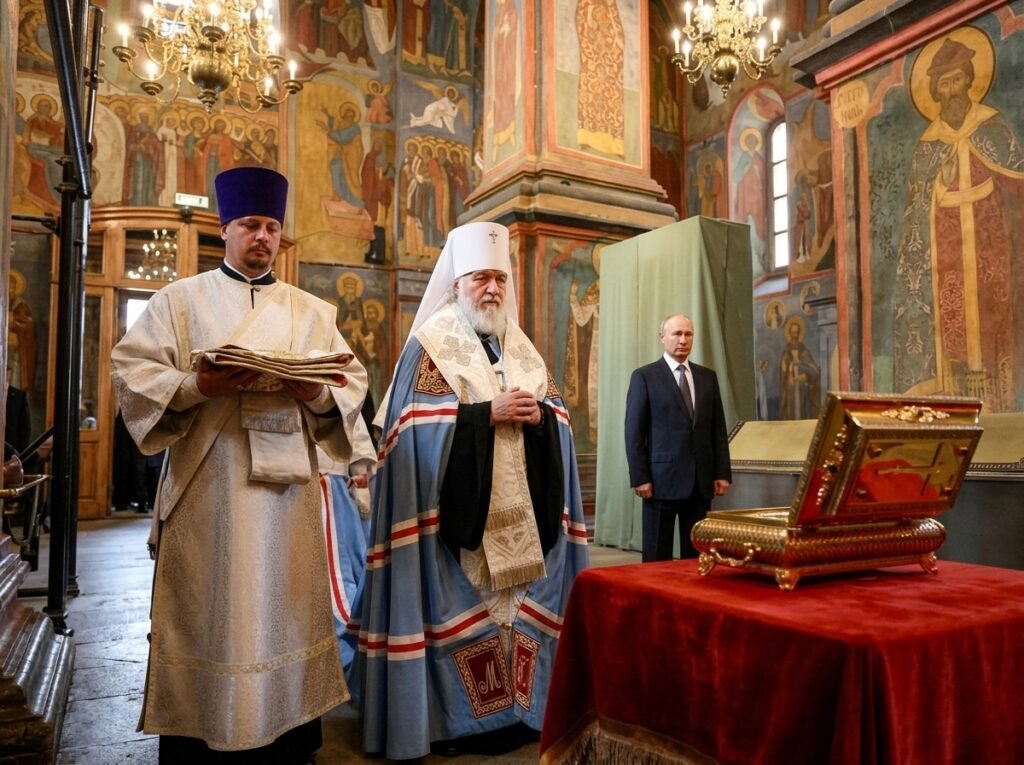
President Vladimir Putin called the discovery of Donskoy’s remains at the Kremlin’s Archangel Cathedral in August “absolutely unique”. While Patriarch Kirill called it a sign of divine providence. Not everyone agrees. Orthodox priest and historian Alexander Zanemonets called the move a “cynical calculation” with nothing to do with genuine faith.
Faith at the Front
Despite the criticism, many soldiers say they’ve turned to religion under pressure. One former Russian serviceman told CNN that makeshift churches and visiting priests have become common at the front, echoing the phrase: “We are Russians. God is with us.”
Yet religious practice inside Russia tells a more complicated story. A 2026 survey found about two-thirds of Russians identify as Orthodox Christians, down from roughly 80% fifteen years ago. Several priests and scholars estimate only about 2% of baptized believers practice regularly.
Still, an annual religious procession in Moscow drew more than 100,000 participants in September. With worshippers carrying a fragment of Donskoy’s relics through the streets. Scholars argue such displays are less about faith and more about demonstrating the church’s ability to mobilize crowds for the state.
Church, State, and Sacrifice
Historian Konstantin Mikhailov describes the relationship as “mutually reinforcing”: the church backs state narratives and gains funding and political support in return. That dynamic has also fueled a growing number of military chaplains at the front.
Critics within the church worry about where spiritual support crosses into propaganda. Patriarch Kirill has said soldiers who die carrying out military duty have made a sacrifice that “washes away all the sins,” a stance that troubles priests like Grigory Mikhnov-Vaytenko. Who left the Russian Orthodox Church after Crimea’s annexation in 2014.
Ukraine formally split from the Russian Orthodox Church in 2019, with the global Orthodox church recognizing an independent Ukrainian church. Mikhnov-Vaytenko argues the Russian church, by backing the war, “blesses its children to kill one another,” since Orthodox Christians make up a majority in both countries.
Not every soldier finds comfort in the relics. One serviceman in Donbas called the practice “a very unconventional solution to our problems in the 21st century”. Adding that such symbols may matter more to grieving families than to troops themselves.
FAQs
Why is Russia sending religious relics to soldiers in Ukraine?
Russia is using relics like those of Prince Dmitry Donskoy to boost troop morale and frame the war as a righteous defense of the homeland, according to religious scholars who spoke to CNN.
Who was Dmitry Donskoy?
Dmitry Donskoy was a medieval Russian prince best known for defeating Mongol forces at the Battle of Kulikovo in 1380. He is celebrated in Russia as a national military hero.
How closely is the Russian Orthodox Church tied to the Kremlin?
Scholars describe the relationship as nearly merged, with the church backing state narratives about the war in exchange for funding and political support from the Kremlin.
What percentage of Russians actually practice Orthodox Christianity?
While about two-thirds of Russians identify as Orthodox, only around 2% of baptized believers attend services regularly, based on data cited by religious scholars and the Russian Interior Ministry.
Did Ukraine split from the Russian Orthodox Church?
Yes. Due to Ukraine Russia War, Ukraine formally broke away from the Russian Orthodox Church in 2019, and the global Orthodox church later recognized an independent Ukrainian Orthodox Church.
What happened to the Alexander Nevsky relics?
Relics of Prince Alexander Nevsky were sent to Russian troops earlier in the war, but unverified reports later claimed they had gone missing before the Donskoy remains were sent instead.