
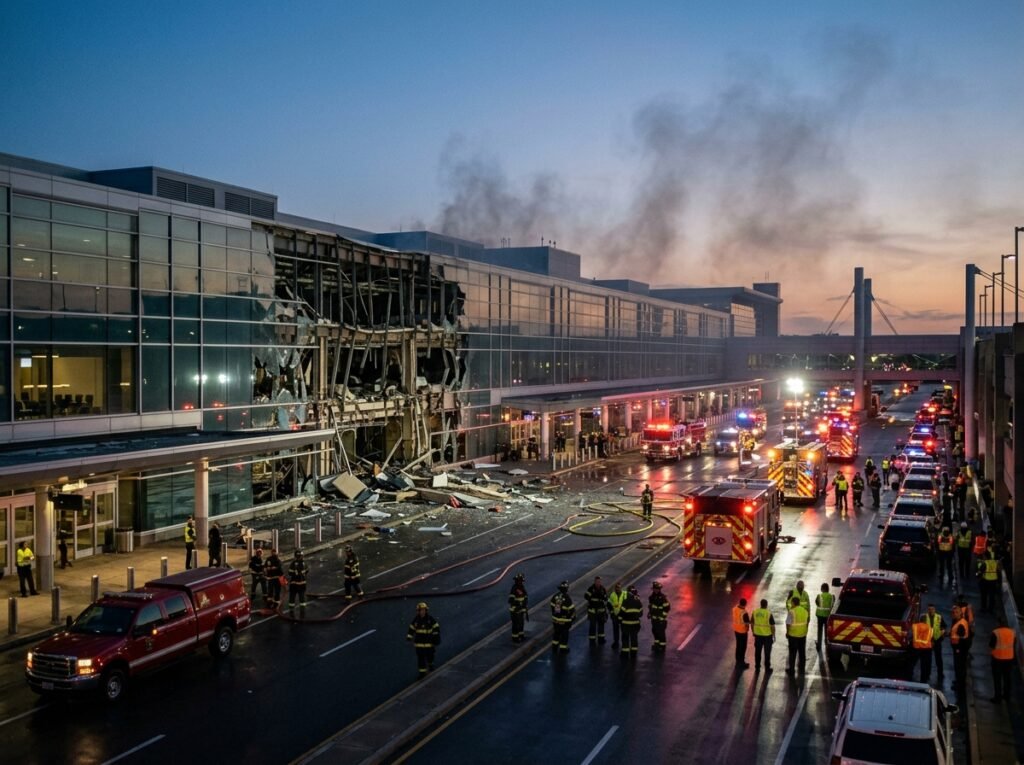
Riyadh Airport Attack Kills Three Saudis as Houthi Missiles Strike
Three Saudi nationals were killed on Thursday in a Riyadh airport attack after Yemen’s Houthi movement said it had fired ballistic missiles at the facility, the country’s civil aviation authority confirmed. The strikes also left a number of Saudi citizens and foreign residents injured, according to a statement from the General Authority of Civil Aviation posted on X.
The attack unfolded in two stages. The first hit the airport grounds directly. The second struck an aircraft belonging to the state carrier Saudia, killing one of the airline’s pilots, the company confirmed in its own statement. Air traffic at the airport has since returned to normal operations.
Houthis Claim Responsibility for Missile Strikes
The Houthi group said on Thursday it had launched two ballistic missiles at the Riyadh facility. In the same statement, the Iran-aligned movement claimed it had also targeted an airport in Najran, a city near the Yemen-Saudi border, along with the Khamis Mushait air base further north. Saudi authorities have not confirmed either of these additional claims.
A Houthi military spokesman described the strikes as a direct response to what he called “Saudi aggression,” citing 60 air strikes and missile attacks carried out against Yemen in the preceding 24 hours. The group has repeatedly said its campaign targets Saudi Arabia over the kingdom’s continued backing of Yemeni government forces in the country’s civil war.
Third Attack in Under a Week
Thursday’s missile attack is the latest in a string of strikes on Saudi aviation infrastructure. Just days earlier, on October 6 and 7, Houthi attacks on two separate Saudi airports killed three people in total.
Abha International Airport took the heaviest toll, with two people killed and 28 wounded. A separate strike at King Khalid International Airport in Riyadh killed one more person.
Escalation Tied to Red Sea Fighting
This latest Riyadh airport attack comes as fighting intensifies between Yemen’s Saudi-backed government forces and the Houthis, who control most of the country’s north-west region. The conflict has sharpened in recent weeks after Houthi forces seized key sections of Yemen’s Red Sea coastline in a fast-moving offensive.
Among the territory captured was the port of Mokha, which sits on the Bab al-Mandab Strait, the narrowest point of the Red Sea and a critical passage for global shipping traffic. Yemeni pro-government forces have since said they recaptured control of the strait’s southern end.
Background: A Decade of Conflict
A Saudi-led military coalition formed in 2015. A group of Arab nations joined together to stop the Houthis from seizing full control of Yemen. They acted to protect the country’s internationally recognised government.
A temporary ceasefire took hold in 2022. It followed years of air strikes and ground combat. The fighting killed hundreds of thousands of people and created one of the world’s most severe humanitarian crises. That informal truce began breaking down in July.
Since then, the Houthis have declared a “maritime embargo” against Saudi Arabia. They resumed missile and drone attacks on Saudi airports, oil facilities, and tankers moving through the Red Sea. The group says these actions are retaliation for a years-long Saudi blockade. They also point to a Saudi air strike on Sanaa airport.
FAQs
Q1: What happened at the Riyadh airport attack this week?
Two Houthi missile strikes hit Riyadh’s international airport on Thursday, killing three Saudi nationals and injuring several others. One attack hit the airport directly while the second struck a Saudia aircraft, killing a pilot.
Q2: Why did the Houthis attack Saudi airports?
The Houthi movement says the strikes are retaliation for Saudi air strikes and missile attacks on Yemen, part of its broader campaign against Saudi Arabia’s support for Yemen’s internationally recognised government.
Q3: How many people have died in recent Houthi missile attacks on Saudi Arabia?
Including the latest Riyadh strikes, at least six people have died in Houthi attacks on Saudi airports since October 6, with dozens more wounded, mainly at Abha International Airport.
Q4: Did Iran play a role in the missile attacks?
The Houthis are widely described as an Iran-aligned group, and reports often reference this backing when covering Iranian missile attack claims tied to the conflict, though Saudi Arabia has not formally attributed the strikes to Iran directly.
Q5: What is happening in Yemen’s civil war right now?
Fighting has escalated sharply in recent weeks, with the Houthis seizing parts of Yemen’s Red Sea coastline, including the port of Mokha, before pro-government forces said they regained control of the Bab al-Mandab Strait.
Q6: Is it safe to fly through Riyadh airport after the attack?
Saudi aviation authorities confirmed that air traffic at the airport returned to normal following the strikes, though officials have not issued a public safety advisory beyond their official statement.
Q7: What was the Bab al-Mandab Strait conflict about?
The strait is a key global shipping chokepoint at the southern end of the Red Sea. Houthi forces captured nearby territory during their offensive before Yemeni government-aligned forces said they secured the strait.